
 Industry and Academia Look at How New Hampshire Can Prepare the Workforce for Life Sciences Growth
While the state’s private sector workforce grew 4% from 2019 to 2025, the life sciences sector outpaced it, growing 24%, according to the NH Department of Employment Security.
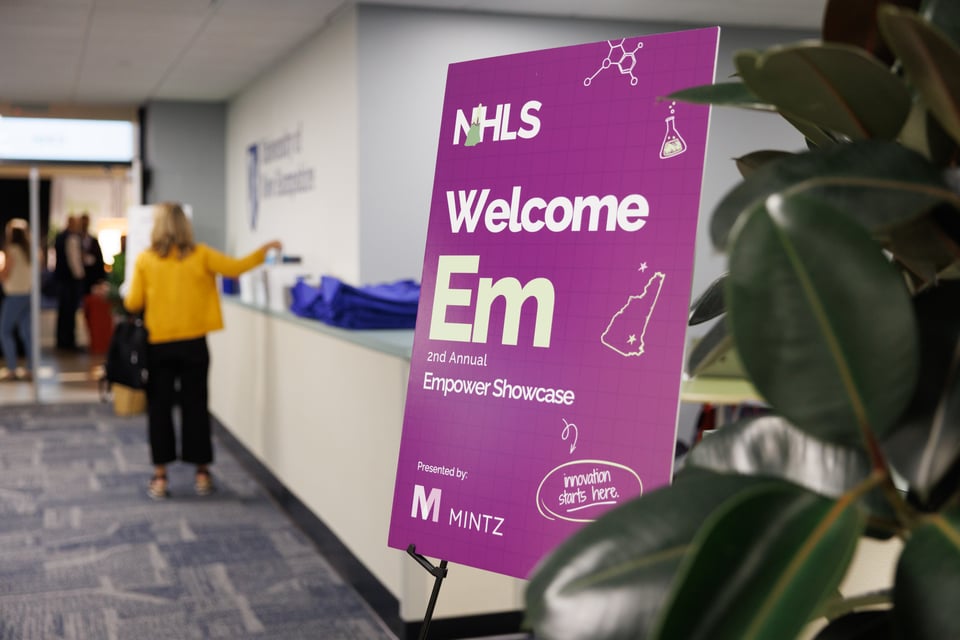
“Our industry is growing,” said Andrea Hechavarria, president of NH Life Sciences at its Empower event on Sept. 9. “We want our workforce to grow with us.”
At Empower, industry members outlined the people and skills they need while college representatives discussed how to prepare students for careers that are evolving as quickly as the sector itself.
University of New Hampshire President Elizabeth Chilton, in conversation with Hechavarria and Dean Zioze of Mintz said health and life sciences are among UNH’s strategic areas of differentiation. Federally funded bio and biomedical research at the school has tripled in the past seven years, to now more than $14 million.
Hechavarria and Chilton emphasized that successful life sciences clusters often have a strong research university at their center.
More than 50 life sciences firms have recruited students on campus over the last five years, Chilton said. Businesses currently connect with the university through faculty relationships, official programs and what Chilton described as many “backdoors.” To make it easier for companies to find qualified students and university partners, UNH is exploring a more “concierge” model.
“We are trying to lean in more to being more accessible,” Chilton said. “I've heard this phrase that UNH is a hidden gem, and we don't want to be hidden anymore.”
When companies do connect with UNH, the relationship can be fruitful. Chilton cited Lonza as the “gold standard” of partnership. The partnership encompasses scholarships, internships, research collaboration, professional development and employee training. Chilton said about one-third of Lonza’s New Hampshire employees are graduates of the University System of New Hampshire.
However, companies don’t need a Lonza-sized relationship to get started. An internship, capstone, faculty relationship or targeted training project can be an entry point.
During the first panel, Theresa Edick of BA Sciences, Dan Harris of HiArc, Jean-Paul Ouellette of Lonza and Conor Cullinane of Pirouette Pharma Inc. emphasized that life sciences careers extend well beyond scientists in labs and may look different from what students expect.
Those opportunities span production floors, laboratories and corporate offices. Ouellette said Lonza’s team in New Hampshire is about one-third manufacturing, one-third quality and testing and one-third support services.
Cullinane said that for a startup like Pirouette Pharma Inc., with its much smaller staff, employees who understand the whole process can punch above their weight class. Through its Pirouette Academy, new hires will spend their first year gaining experience across different parts of the business.
Transferable skills such as adaptability, communication, problem-solving and critical thinking will carry students throughout their careers. Hands-on coursework or experiential learning are opportunities to practice.
During the second panel, UNH professors Sherine Elsawa, Samuel Carton and Peter Lane, along with Matt Simon, executive director of the UNH Biotech Innovation Center, discussed what colleges are already doing and what they need from industry.
“We don’t have a talent problem,” Simon said. “We have a talent alignment problem for the life sciences.”
With such rapid employment growth in life sciences, higher education can’t adjust instantaneously. Colleges need industry to communicate future needs earlier, so programs and coursework can better align with emerging workforce needs. It’s too late if companies start the conversation only when looking to hire graduates.
For NHLS, better alignment is one way to help the workforce keep pace with the industry’s growth.
“I'm just proud to say that all the companies here today have boots on the ground in New Hampshire and are innovating to ultimately improve patient lives,” Hechavarria said. “I believe more so than ever that New Hampshire is really at a place in time to be a pre-eminent destination for this type of innovation.”


